 |
データシートサーチシステム |
|
|
データシートサーチシステム |
|
The question interval is too short.
Please try again in a few seconds.

Hello, Please ask a question about AD8307AN Datasheet
# Example questions:
➢ Examine figure 15 and figure 16. what is being measured in these figures, and what key performance characteristic do they demonstrate regarding the ad8307?
➢ ' what factors (e.g., temperature, input signal parameters, buffer configurations) can influence the accuracy or linearity of the ad8307’s logarithmic response?
➢ What is the purpose of the 'int' pin in figure 9, figure 10, and figure 11, and how does adjusting its voltage affect the output signal?
| Part No. | AD8307AN |
| Manufacturer | AD |
| Size | 508 Kbytes |
| Pages | 24 pages |
| Description | Low Cost DC-500 MHz, 92 dB Logarithmic Amplifier |








1. Overview/Functionality
️· The AD8307 is a high-performance, low-noise logarithmic detector/attenuator. This means it takes an input signal, converts its amplitude into a logarithmic output, and effectively reduces its power level.
️· It's used for measuring signal power in various applications, especially RF and microwave systems.
2. Key Features & Specifications (highlights):
️· Dynamic Range: The datasheet emphasizes a wide dynamic range (specific values will depend on setup, see figures)
️· Linearity: It’s a very linear device, essential for accurate power measurements.
️· Noise Performance: Low noise allows for reliable detection of weak signals.
️· Power Supply: Operates with a single power supply, typically 3V – 5V.
️· Input Signal: Accepts a wide range of input signal levels.
️· Response Time: Fast response time for dynamic signal analysis.
️· Intercept Adjustment: Allows for calibration to optimize performance.
3. Applications (inferred from figures and notes):
️· RF and Microwave Signal Measurement: Primary application.
️· Spectrum Analyzer Applications: Possible use for signal analysis.
️· Power Monitoring: Measuring signal power in various systems.
4. Important Figures and Graphs (and their meaning):
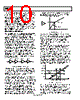
️· Figure 11 (V_OUT vs. Input Level at Three Temperatures): Shows the AD8307's output voltage changes with varying input signal levels at different temperatures (-40°C, +25°C, +85°C). Helps understand temperature dependence.
️· Figure 12 (Log Conformance vs. Input at 400MHz): Shows linearity of the detector, essential for precise power measurement
️· Figure 14 (V_OUT vs. Input Level at 3V): Illustrates how the output voltage changes with different input signal levels when the device is powered with 3V.
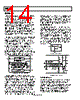
️· Figure 15 & 16 (Power-Up/Power-Down Response Time): Shows how quickly the device responds to power-on and power-off conditions.
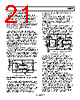
️· Figure 18 (V_OUT Pulse Response): Illustrates the output response to a pulsed input signal.
5. Test Setup & Considerations:
️· Figure 17 (Power-Up/Down Setup): Demonstrates a recommended test setup for measuring the power-up and power-down response times.
️· Figure 20 (Pulse Response Setup): Demonstrates a recommended test setup for measuring the pulse response time.
️· Use of FET Probes: The datasheet emphasizes using FET probes during measurements.
️· NC = No Connect: Some pins are designated as "NC" (No Connect) and should not be connected.
6. Performance Details (from figures and notes):
️· Power-Up Response: The AD8307 responds quickly to a power-up signal, settling within a short time.
️· Power-Down Response: Similarly, it shuts down rapidly when power is removed.
️· Intercept Point Adjustment: The datasheet highlights the ability to adjust the intercept point to optimize performance. This is a calibration step to ensure accuracy.
️· Input Signal Conditioning: The input signal often needs some conditioning before being fed to the AD8307. This may include amplification or attenuation.
️· Output Signal Conditioning: The logarithmic output is typically processed further.
IMPORTANT CAVEATS:
️· Image/Text Interpretation: This summary is based on images and text. Certain values or detailed specifications might be missing or misinterpreted due to the limitations of visual data. The full datasheet is required for precise engineering decisions.
️· Figure Dependencies: Many aspects of performance (linearity, dynamic range, response times) are *highly dependent* on the specific test setup used to generate the figures. The conditions shown in the figures (input signal levels, termination, external components) are critical.
️· Technical Jargon: I've tried to simplify the language, but some technical terms are inherent to the description. A deeper understanding of logarithmic detectors and RF/microwave principles is necessary for full comprehension.
️· Missing Information: This is *not* a complete datasheet. There are likely to be other sections (electrical characteristics, mechanical dimensions, ordering information) that are not represented here.
️· Application Specifics: The AD8307's performance in a real application is dependent on the entire system design, not just the device itself.
1. Overview/Functionality
️· The AD8307 is a high-performance, low-noise logarithmic detector/attenuator. This means it takes an input signal, converts its amplitude into a logarithmic output, and effectively reduces its power level.
️· It's used for measuring signal power in various applications, especially RF and microwave systems.
2. Key Features & Specifications (highlights):
️· Dynamic Range: The datasheet emphasizes a wide dynamic range (specific values will depend on setup, see figures)
️· Linearity: It’s a very linear device, essential for accurate power measurements.
️· Noise Performance: Low noise allows for reliable detection of weak signals.
️· Power Supply: Operates with a single power supply, typically 3V – 5V.
️· Input Signal: Accepts a wide range of input signal levels.
️· Response Time: Fast response time for dynamic signal analysis.
️· Intercept Adjustment: Allows for calibration to optimize performance.
3. Applications (inferred from figures and notes):
️· RF and Microwave Signal Measurement: Primary application.
️· Spectrum Analyzer Applications: Possible use for signal analysis.
️· Power Monitoring: Measuring signal power in various systems.
4. Important Figures and Graphs (and their meaning):
️· Figure 11 (V_OUT vs. Input Level at Three Temperatures): Shows the AD8307's output voltage changes with varying input signal levels at different temperatures (-40°C, +25°C, +85°C). Helps understand temperature dependence.
️· Figure 12 (Log Conformance vs. Input at 400MHz): Shows linearity of the detector, essential for precise power measurement
️· Figure 14 (V_OUT vs. Input Level at 3V): Illustrates how the output voltage changes with different input signal levels when the device is powered with 3V.
️· Figure 15 & 16 (Power-Up/Power-Down Response Time): Shows how quickly the device responds to power-on and power-off conditions.
️· Figure 18 (V_OUT Pulse Response): Illustrates the output response to a pulsed input signal.
5. Test Setup & Considerations:
️· Figure 17 (Power-Up/Down Setup): Demonstrates a recommended test setup for measuring the power-up and power-down response times.
️· Figure 20 (Pulse Response Setup): Demonstrates a recommended test setup for measuring the pulse response time.
️· Use of FET Probes: The datasheet emphasizes using FET probes during measurements.
️· NC = No Connect: Some pins are designated as "NC" (No Connect) and should not be connected.
6. Performance Details (from figures and notes):
️· Power-Up Response: The AD8307 responds quickly to a power-up signal, settling within a short time.
️· Power-Down Response: Similarly, it shuts down rapidly when power is removed.
️· Intercept Point Adjustment: The datasheet highlights the ability to adjust the intercept point to optimize performance. This is a calibration step to ensure accuracy.
️· Input Signal Conditioning: The input signal often needs some conditioning before being fed to the AD8307. This may include amplification or attenuation.
️· Output Signal Conditioning: The logarithmic output is typically processed further.
IMPORTANT CAVEATS:
️· Image/Text Interpretation: This summary is based on images and text. Certain values or detailed specifications might be missing or misinterpreted due to the limitations of visual data. The full datasheet is required for precise engineering decisions.
️· Figure Dependencies: Many aspects of performance (linearity, dynamic range, response times) are *highly dependent* on the specific test setup used to generate the figures. The conditions shown in the figures (input signal levels, termination, external components) are critical.
️· Technical Jargon: I've tried to simplify the language, but some technical terms are inherent to the description. A deeper understanding of logarithmic detectors and RF/microwave principles is necessary for full comprehension.
️· Missing Information: This is *not* a complete datasheet. There are likely to be other sections (electrical characteristics, mechanical dimensions, ordering information) that are not represented here.
️· Application Specifics: The AD8307's performance in a real application is dependent on the entire system design, not just the device itself.
| Part No. | AD8307AN |
| Manufacturer | AD |
| Size | 508 Kbytes |
| Pages | 24 pages |
| Description | Low Cost DC-500 MHz, 92 dB Logarithmic Amplifier |
| ALLDATASHEETはお客様のビジネスに役立ちますか? [ DONATE ] |
Alldatasheetは | 広告 | お問い合わせ | プライバシーポリシー | データシートへのリンク | リンク交換 | メーカーリスト All Rights Reserved©Alldatasheet.com |
| Russian : Alldatasheetru.com | Korean : Alldatasheet.co.kr | Spanish : Alldatasheet.es | French : Alldatasheet.fr | Italian : Alldatasheetit.com Portuguese : Alldatasheetpt.com | Polish : Alldatasheet.pl | Vietnamese : Alldatasheet.vn Indian : Alldatasheet.in | Mexican : Alldatasheet.com.mx | British : Alldatasheet.co.uk | New Zealand : Alldatasheet.co.nz |
|
Family Site : ic2ic.com |
icmetro.com |
 Japanese ▼
  English
 Chinese
 German
 Russian
 Korean
 Spanish
 French
 Italian
 Portuguese
 Polish
 Vietnamese
 Indian
 Mexican
 British
 New Zealand