 |
データシートサーチシステム |
|
|
データシートサーチシステム |
|
The question interval is too short.
Please try again in a few seconds.

Hello, Please ask a question about T830-700W Datasheet
# Example questions:
➢ What is the maximum allowable value for dimension 'f1' in inches?
➢ What is the minimum value for dimension 'a' in millimeters?
➢ What is the typical value for l2 in millimeters?
| Part No. | T830-700W |
| Manufacturer | STMICROELECTRONICS |
| Size | 108 Kbytes |
| Pages | 5 pages |
| Description | SNUBBERLESS TRIAC |


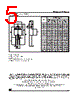

This document appears to be a datasheet for a TRIAC, likely the STMicroelectronics T820 or T830 series. It contains a comprehensive set of electrical and mechanical characteristics. Here's a breakdown of the information contained within, categorized for clarity:
1. Electrical Characteristics:
️· Static Characteristics (VTM, IGT, VH, etc.): Defines the voltages and currents required for the TRIAC to turn on and remain on.
️· Dynamic Characteristics (Commutation time, Rise time): Describes how quickly the TRIAC switches.
️· Blocking Characteristics (VRRM, VRRM): Specifies the maximum reverse voltage the TRIAC can withstand without breaking down.
️· Trigger Characteristics (IGT, VGT): Details the gate current/voltage needed to initiate conduction.
️· Thermal Characteristics (Rthjc, Rthja): Important for understanding heat dissipation and preventing overheating. Includes junction-to-case and junction-to-ambient thermal resistance.
️· Surge Protection (I2t value, TSM): Defines the TRIAC's ability to withstand short-duration, high-current surges.
️· Commutation Characteristics: Parameters relating to the TRIAC's ability to switch off.
2. Key Electrical Parameters Highlighted:
️· ITM (On-State RMS Current): The maximum RMS current the TRIAC can handle continuously.
️· VTM (On-State Voltage): The voltage drop across the TRIAC when it's conducting.
️· IGT (Gate Trigger Current): The current needed at the gate to trigger the TRIAC.
️· I2t Value: Critical for understanding surge withstand capability.
️· TSM (Surge Peak Current): The maximum surge current the TRIAC can withstand.
3. Thermal Management:
️· Emphasis on Rthjc (Thermal resistance from junction to case) and Rthja (Thermal resistance from junction to ambient). This data is crucial for designing proper heat sinking.
️· Tj (Junction Temperature): The maximum allowable junction temperature is critical for reliability.
4. Mechanical Dimensions:
️· Detailed mechanical drawings showing the package outline.
️· Dimensions are given in both millimeters and inches.
️· This section is essential for PCB layout and physical integration of the component.
5. Ref. and Dimensions table
️· A table outlining various reference points and the min/max dimensions of the package, crucial for PCB layout.
In summary, this datasheet provides all the necessary information for engineers to design a circuit incorporating the STMicroelectronics T820/T830 TRIAC, ensuring proper operation, thermal management, and mechanical integration.
1. Electrical Characteristics:
️· Static Characteristics (VTM, IGT, VH, etc.): Defines the voltages and currents required for the TRIAC to turn on and remain on.
️· Dynamic Characteristics (Commutation time, Rise time): Describes how quickly the TRIAC switches.
️· Blocking Characteristics (VRRM, VRRM): Specifies the maximum reverse voltage the TRIAC can withstand without breaking down.
️· Trigger Characteristics (IGT, VGT): Details the gate current/voltage needed to initiate conduction.
️· Thermal Characteristics (Rthjc, Rthja): Important for understanding heat dissipation and preventing overheating. Includes junction-to-case and junction-to-ambient thermal resistance.
️· Surge Protection (I2t value, TSM): Defines the TRIAC's ability to withstand short-duration, high-current surges.
️· Commutation Characteristics: Parameters relating to the TRIAC's ability to switch off.
2. Key Electrical Parameters Highlighted:
️· ITM (On-State RMS Current): The maximum RMS current the TRIAC can handle continuously.
️· VTM (On-State Voltage): The voltage drop across the TRIAC when it's conducting.
️· IGT (Gate Trigger Current): The current needed at the gate to trigger the TRIAC.
️· I2t Value: Critical for understanding surge withstand capability.
️· TSM (Surge Peak Current): The maximum surge current the TRIAC can withstand.
3. Thermal Management:
️· Emphasis on Rthjc (Thermal resistance from junction to case) and Rthja (Thermal resistance from junction to ambient). This data is crucial for designing proper heat sinking.
️· Tj (Junction Temperature): The maximum allowable junction temperature is critical for reliability.
4. Mechanical Dimensions:
️· Detailed mechanical drawings showing the package outline.
️· Dimensions are given in both millimeters and inches.
️· This section is essential for PCB layout and physical integration of the component.
5. Ref. and Dimensions table
️· A table outlining various reference points and the min/max dimensions of the package, crucial for PCB layout.
In summary, this datasheet provides all the necessary information for engineers to design a circuit incorporating the STMicroelectronics T820/T830 TRIAC, ensuring proper operation, thermal management, and mechanical integration.
| Part No. | T830-700W |
| Manufacturer | STMICROELECTRONICS |
| Size | 108 Kbytes |
| Pages | 5 pages |
| Description | SNUBBERLESS TRIAC |
| ALLDATASHEETはお客様のビジネスに役立ちますか? [ DONATE ] |
Alldatasheetは | 広告 | お問い合わせ | プライバシーポリシー | データシートへのリンク | リンク交換 | メーカーリスト All Rights Reserved©Alldatasheet.com |
| Russian : Alldatasheetru.com | Korean : Alldatasheet.co.kr | Spanish : Alldatasheet.es | French : Alldatasheet.fr | Italian : Alldatasheetit.com Portuguese : Alldatasheetpt.com | Polish : Alldatasheet.pl | Vietnamese : Alldatasheet.vn Indian : Alldatasheet.in | Mexican : Alldatasheet.com.mx | British : Alldatasheet.co.uk | New Zealand : Alldatasheet.co.nz |
|
Family Site : ic2ic.com |
icmetro.com |
 Japanese ▼
  English
 Chinese
 German
 Russian
 Korean
 Spanish
 French
 Italian
 Portuguese
 Polish
 Vietnamese
 Indian
 Mexican
 British
 New Zealand