 |
データシートサーチシステム |
|
|
データシートサーチシステム |
|
The question interval is too short.
Please try again in a few seconds.

Hello, Please ask a question about AD1833ACST Datasheet
# Example questions:
➢ The document mentions several performance characteristics like 'pass-band ripple' and 'stop-band attenuation'. explain, in your own words, the difference between these two terms.
➢ What is the primary function of the filtr and filtd pins?
➢ At what frequency does the transition band begin to significantly attenuate the signal in 8khz mode (referring to tpc 1 & 2)?
| Part No. | AD1833ACST |
| Manufacturer | AD |
| Size | 687 Kbytes |
| Pages | 20 pages |
| Description | 24-Bit, 192 kHz, DAC |







1. Overview
️· The AD1833A appears to be a digital decimator/filter, likely intended for audio processing. It's designed to reduce the sample rate of a digital audio signal while filtering out unwanted frequencies.
️· The document provides performance characteristics and definitions associated with audio filters and ADCs.
️· It's presented as an excerpt, so it does not describe the entire device.
2. Key Features (Implied from Content)
️· Decimation/Filtering: Reduces sample rates while filtering.
️· Multiple Filter Modes: It supports different filter configurations (mentioned as 8-mode and 4-mode). The documentation does not explain the specifics of these modes.
️· Audio-Focused: Designed for audio applications.
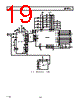
️· Flexibility (implied): The presence of various input/output pins (FILTR, FILTD, etc.) suggests a degree of configurability.
3. Performance Characteristics (TPCs - Typical Performance Characteristics)
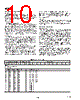
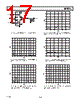
The document includes a number of "TPC" graphs that visually represent the device's performance. Here's a summary of what they show:
️· TPC 1: Pass-Band Response, 8-mode: Shows a relatively flat frequency response within the passband (the range of frequencies meant to be preserved).
️· TPC 2: Transition Band Response, 8-mode: Illustrates the rate at which the signal attenuates as frequencies move *outside* the passband.
️· TPC 3: Complete Response, 8-mode: A broader view of the filter's response across a wider range of frequencies.
️· TPC 4: Pass-Band Response, 4-mode: Similar to TPC 1 but for the 4-mode filter.
️· TPC 5: 40 kHz Pass-Band Response, 4-mode: Shows the response at higher frequencies, specifically around 40 kHz, in 4-mode.
️· TPC 6: Transition Band Response, 4-mode: The transition band response for 4-mode.
4. Definitions
The document defines several terms common in audio processing and filter design. These include:
️· Dynamic Range: The ratio of a full-scale input signal to the integrated input noise.
️· Signal to (THD + N): The ratio of signal strength to total harmonic distortion plus noise.
️· Pass Band: The frequency range unaffected by the filter's attenuation.
️· Pass-Band Ripple: Variation in the amplitude response within the passband.
️· Stop Band: The frequency range heavily attenuated by the filter.
️· Gain Error: Deviation of actual output from expected output.
️· Interchannel Gain Mismatch: Difference in output levels between stereo channels.
️· Gain Drift: Change in gain with temperature changes.
️· Crosstalk: Signal bleed between channels.
️· Power Supply Rejection: The filter's ability to block power supply noise.
️· Group Delay: A measure of how signal pulses are delayed as they pass through the filter.
️· Group Delay Variation: Change in group delay over frequencies.
Important Notes:
️· Excerpt: This is an excerpt, not the complete datasheet. Many aspects of the AD1833A are not described.
️· Technical Audience: The document is clearly intended for engineers familiar with digital audio processing and filter design.
️· Further Investigation: To fully understand the AD1833A, you would need the full datasheet.
1. Overview
️· The AD1833A appears to be a digital decimator/filter, likely intended for audio processing. It's designed to reduce the sample rate of a digital audio signal while filtering out unwanted frequencies.
️· The document provides performance characteristics and definitions associated with audio filters and ADCs.
️· It's presented as an excerpt, so it does not describe the entire device.
2. Key Features (Implied from Content)
️· Decimation/Filtering: Reduces sample rates while filtering.
️· Multiple Filter Modes: It supports different filter configurations (mentioned as 8-mode and 4-mode). The documentation does not explain the specifics of these modes.
️· Audio-Focused: Designed for audio applications.
️· Flexibility (implied): The presence of various input/output pins (FILTR, FILTD, etc.) suggests a degree of configurability.
3. Performance Characteristics (TPCs - Typical Performance Characteristics)
The document includes a number of "TPC" graphs that visually represent the device's performance. Here's a summary of what they show:
️· TPC 1: Pass-Band Response, 8-mode: Shows a relatively flat frequency response within the passband (the range of frequencies meant to be preserved).
️· TPC 2: Transition Band Response, 8-mode: Illustrates the rate at which the signal attenuates as frequencies move *outside* the passband.
️· TPC 3: Complete Response, 8-mode: A broader view of the filter's response across a wider range of frequencies.
️· TPC 4: Pass-Band Response, 4-mode: Similar to TPC 1 but for the 4-mode filter.
️· TPC 5: 40 kHz Pass-Band Response, 4-mode: Shows the response at higher frequencies, specifically around 40 kHz, in 4-mode.
️· TPC 6: Transition Band Response, 4-mode: The transition band response for 4-mode.
4. Definitions
The document defines several terms common in audio processing and filter design. These include:
️· Dynamic Range: The ratio of a full-scale input signal to the integrated input noise.
️· Signal to (THD + N): The ratio of signal strength to total harmonic distortion plus noise.
️· Pass Band: The frequency range unaffected by the filter's attenuation.
️· Pass-Band Ripple: Variation in the amplitude response within the passband.
️· Stop Band: The frequency range heavily attenuated by the filter.
️· Gain Error: Deviation of actual output from expected output.
️· Interchannel Gain Mismatch: Difference in output levels between stereo channels.
️· Gain Drift: Change in gain with temperature changes.
️· Crosstalk: Signal bleed between channels.
️· Power Supply Rejection: The filter's ability to block power supply noise.
️· Group Delay: A measure of how signal pulses are delayed as they pass through the filter.
️· Group Delay Variation: Change in group delay over frequencies.
Important Notes:
️· Excerpt: This is an excerpt, not the complete datasheet. Many aspects of the AD1833A are not described.
️· Technical Audience: The document is clearly intended for engineers familiar with digital audio processing and filter design.
️· Further Investigation: To fully understand the AD1833A, you would need the full datasheet.
| Part No. | AD1833ACST |
| Manufacturer | AD |
| Size | 687 Kbytes |
| Pages | 20 pages |
| Description | 24-Bit, 192 kHz, DAC |
| ALLDATASHEETはお客様のビジネスに役立ちますか? [ DONATE ] |
Alldatasheetは | 広告 | お問い合わせ | プライバシーポリシー | データシートへのリンク | リンク交換 | メーカーリスト All Rights Reserved©Alldatasheet.com |
| Russian : Alldatasheetru.com | Korean : Alldatasheet.co.kr | Spanish : Alldatasheet.es | French : Alldatasheet.fr | Italian : Alldatasheetit.com Portuguese : Alldatasheetpt.com | Polish : Alldatasheet.pl | Vietnamese : Alldatasheet.vn Indian : Alldatasheet.in | Mexican : Alldatasheet.com.mx | British : Alldatasheet.co.uk | New Zealand : Alldatasheet.co.nz |
|
Family Site : ic2ic.com |
icmetro.com |
 Japanese ▼
  English
 Chinese
 German
 Russian
 Korean
 Spanish
 French
 Italian
 Portuguese
 Polish
 Vietnamese
 Indian
 Mexican
 British
 New Zealand