|
Features
For convenience, features have been organized to reflect:
• Standard features of the MC68HC908EY16
• Features of the CPU08
Standard features of the MC68HC908EY16 include:
• High-performance M68HC08 architecture optimized for
C-compilers
• Fully upward-compatible object code with M6805, M146805, and
M68HC05 Families
• 8-MHz internal bus frequency at 5V, 4MHZ at 3V
• Internal oscillator requiring no external components:
– Software selectable bus frequencies
– 25 percent accuracy with trim capability to 2 percent
– Clock monitor
– Option to allow use of external clock source or external
crystal/ceramic resonator
• 15,872 bytes of on-chip FLASH memory with in-circuit
programming
• FLASH program memory security1
• 512 bytes of on-chip random-access memory (RAM)
• Low voltage inhibit (LVI) module with software selectable trip
points for 5V and 3V operation.
• Internal clock generator module (ICG)
• Two 16-bit, 2-channel timer (TIMA and TIMB) interface modules
with selectable input capture, output compare, and pulse-width
modulation (PWM) capability on each channel
• 8-channel, 10-bit successive approximation analog-to-digital
converter (ADC)
• Enhanced serial communications interface module (ESCI) for
local interconnect network (LIN) connectivity
• Serial peripheral interface (SPI)
• Timebase Module (TBM)
• 5-bit keyboard interrupt (KBI) with wakeup feature
• 24 general-purpose input/output (I/O) pins
• External asynchronous interrupt pin with internal pullup (IRQB)
• System protection features:
– Optional computer operating properly (COP) reset
– Illegal opcode detection with reset
– Illegal address detection with reset
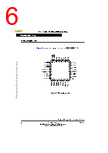
• 32-pin quad flat pack (QFP) package
• Low-power design; fully static with stop and wait modes
• Internal pullups on IRQB and RSTB to reduce customer system
cost
• Standard low-power modes of operation:
– Wait mode
– Stop mode
• Master reset pin (RSTB) and power-on reset (POR)
• BREAK module (BRK) to allow single breakpoint setting during
in-circuit debugging
• Higher current source capability on nine port lines for LED drive
(PTA6/SS, PTA5/SPSCK, PTA4/KDB4, PTA3/KBD3,
PTA2/KBD2, PTA1/KBD1, PTA0/KBD0, PTC1/MOSI, and
PTC0/MISO)
Features of the CPU08 include:
• Enhanced HC05 programming model
• Extensive loop control functions
• 16 addressing modes (eight more than the HC05)
• 16-bit index register and stack pointer
• Memory-to-memory data transfers
• Fast 8 × 8 multiply instruction
• Fast 16 ÷ 8 divide instruction
• Binary-coded decimal (BCD) instructions
• Optimization for controller applications
• Third party C language support
|


 Japanese ▼
  English
 Chinese
 German
 Russian
 Korean
 Spanish
 French
 Italian
 Portuguese
 Polish
 Vietnamese
 Indian
 Mexican
 British
 New Zealand